
RE 4 Healing: Crossborder Remembrance, Reconnection, Restoring and Resilience
Project data
Project title: RE 4 Healing: Crossborder Remembrance, Reconnection,
Restoring and Resilience
Acronym: RE4 Healing
Project type: CERV Lump Sum Grants
Project coordinator: Univerza na Primorskem, Fakulteta za humanistične študije / University of Primorska, Faculty of Humanities
Project leader: prof. dr. Katja Hrobat Virloget
Project partners:
Zavod Epiona;
Associazione Culturale Quarantasettezeroquattro;
Pädagogische Hochschule Kärnten;
Fixmedia, Zavod za razvoj filmske ustvarjalnosti Ljubljana;
Cultural Heritage Directorate Ministry of Culture, Slovenia (associated partner)
Financing: European Commission, Citizens, Equality, Rights and Values Programme (CERV)
Duration: 1. 3. 2025-28. 2. 2027
Funded by the European Union. Views and opinions expressed are however those of the author(s) only and do not necessarily reflect those of the European Union.Neither the European Union nor the granting authority can be held responsible for them.
Project documentation

Work Packages
Work Package 1: Production and Discussion of the Documentary Film
Lead Beneficiary: Fixmedia, Institute for development of film creativity (Fixmedia)
Documentary film trailer Sence tišin / Le ombre del silenzio / Die Schatten der Stille / Shadows of Silence
https://vimeo.com/1211469602?share=copy&fl=sv&fe=ci
At the EPIC Center in Nova Gorica, the documentary film Shadows of Silence (Sence tišine) had its world premiere as part of the 14. Letni kino Silvana Furlana – kino pod zvezdami. The film opens up a space for dialogue about issues that have been difficult to talk about for many years, and the weight of this silence is something that is all too familiar in Slovenia. The film was met with great enthusiasm at its premiere. More: https://obalaplus.si/film-sence-tisine-premierno-v-novi-gorici-pripoved-o-mejah-zgodovini-in-cloveskih-usodah/
______
We plan to produce a 30 min documentary film. At six divisive collective memories from the borderland regions will be included: the Italians, who migrated from Yugoslavia after WWII, the Italians who remained in Yugoslavia after WWII, the immigrants from former Yugoslavian republics in the emptied towns of Istria, the Slovenian minority in Italy who experienced fascist violence, the Slovenian minority in Austria who experienced Nazi violence, the germanized Slovenians from Austria.
Not to let the memories encourage further conflicts and divisions, a professional frame will be given with the interpretations of historians, anthropologists, psychotherapists, and pedagogic university teachers. The aim is to raise public awareness about different and conflicting perceptions and narratives of the past. These are often completely different perceptions of history by people who live in the same areas as neighbours. Addressing the different narratives in an attractive documentary film format, can contribute to a mutual and empathic understanding that leads to the restoration, reconciliation and healing of societies wounded by a difficult past. The film will be screened at multiple film festivals in Slovenia and abroad and on individual projections in Slovenia, Italy and Austria as well as in bordering countries.
Discussions, led by experts, will be organized after each screening to deepen understanding of the topic and give the viewers the possibility to contribute with their own thoughts. All speakers in the film will have the opportunity to voice themselves in their own native languages (i.e. Slovenian, Italian, German) and besides English the subtitles will be provided in all the involved languages in order to show the multi linguistic aspect of borderland communities. Due to the lack of money to translate the subtitles into so many languages, the costs for the subtitles in the film will be covered by the complementary research ongoing project Ethnography of silence(s) of the project leader. There will be no double financing and both financial sources will be indicated and distinguished clearly in the text of the film production.
Work Package 2: Kick-off Workshop in Austria (completed)
Lead Beneficiary: Pädagogische Hochschule Kärnten
Website: https://www.phk.ac.at/
In WP2, 40 people from five countries participated: Austria, Slovenia, Turkey, Poland, and Italy.
This workshop was held partly as open conference, partly as workshop for invited participatants at the PHK, University of Teacher Education Carinthia, Klagenfurt/Celovec. It was dedicated to the thematic area of cultures of remembrance, dealing with social diversity – multilingualism, linguistic and ethnic minorities, minority languages, hybrid identities – as well as the concealment of traumatic experiences in the Alps-Adriatic region and beyond. It also addressed the social opportunities offered by coming to terms with the burdensome past and revitalising historical diversity, with a particular focus on the role of education, art and culture.
The past century was marked by totalitarian and authoritarian regimes, the First and Second World Wars and a multitude of inter-ethnic conflicts. Changes in borders, attempts at assimilation or even the eradication of minorities, ‘forced monolingualism’, flight and migration, and other upheavals have left deep scars in our border regions today. It was not uncommon for former neighbours to become enemies. History and stories were written by the victors, whose views of the past were publicly disseminated. While some memories were openly discussed or even romanticised, others were concealed or denied. During this conference, experts gave interdisciplinary lectures and provided a variety of examples of how successfully coming to terms with the past can lead to the acceptance of social diversity. Discussions after the lectures were an integral and important past.
Important programme parts were e.g. on the 10th of May 2025 :
Katja Hrobat Virloget, Univerza na Primorskem, Koper, Slovenia: Ethnography of Silence. Traumatic Memories, Memory Conflicts, Hybrid Identities on the Former Yugoslav-Italian Border
Franco Finco, Carinthia University of Education: Language minorities in Italy: from the nation state to Sergio Salvi’s ‘Le Lingue tagliate’ (1975) and beyond
Bartłomiej Chromik, PhD, University of Warsaw, Warsaw, Poland: Revitalisation of Wymysiöeryś. The return of memory through the return of language
Danijel Grafenauer, Institute for Ethnic Studies, Ljubljana, Slovenia: Efforts to preserve and revitalise the German-speaking ethnic population in Slovenia after 1991
Musical and Literary Accompaniment: Nikolaj Efendi & Stefan Feinig as artists, they also discussed their artistical content (award-winning lyrics and composed music) with Daniel Wutti from PHK.
The second day, 11th of May 2025, continued with deeped discussion:
Moderated panel discussion: Štefan Čok, Associazione Quarantasettezeroquattro, Trieste, Ilse Geson-Gombos, teacher at WiMo Klagenfurt/Celovec, Gerti Malle, curator of Remembrance Year 2025 Leto spominjanja, Mateja Mesner, Director of VS Bleiburg/Lš Pliberk, Manfred Morokutti, Mauthausen Committee Association Carinthia/Koroška: Inclusive, transnational and contemporary culture of remembrance in school and extracurricular education – opportunities and challenges
Short presentations with panel discussion: Rudolf Winkler, specialist in child and adolescent psychiatry, psychotherapist, Silvia Jelinek, psychotherapist, Aspis Association, Brigitte Opetnik, psychologist and psychotherapist, Aspis Association, and Manca Švara, psychotherapist, Epiona Association. Moderator: Daniel Wutti, Carinthia University of Education: Assimilation – transgenerational trauma – integration. Psychological and psychotherapeutic aspects of traumatic silence, minority languages, discrimination and ‘healing’ or integration
Martina Tonet, Univerza na Primorskem, Koper, Slovenia: Anthropological studies of silence in minority realities: From the indigenous Diné (Navajo) and Runakuna (Quechua) peoples in North and South America to the Slovenes in Trieste
Marko Galič, Univerza na Primorskem, Koper, Slovenia: From historical trauma to the right to self-determination: The case of the Māori in New Zealand
The event finished with a special psychological workshop: Manca Švara, Epiona Association & Daniel Wutti, Carinthia University of Education: Borders within us – collective memory and identity. Creative storytelling and therapeutic workshop
Work Package 3: Arts based psychotherapeutic workshops + discussion (completed)
A total of 84 participants from six countries—Slovenia, Italy, Austria, Bosnia and Herzegovina, Poland, and Hungary—took part in WP3 activities.
The workshops were led by Manca Švara, Jungian psychoanalyst and director of Zavod Epiona. In addition to the originally scheduled program, two additional sessions were organized: the first on April 8 at UNI3, University of the Third Age in Koper; the second on April 14, 2025, at the Koper–Capodistria Gymnasium, as part of the regional NGO presentations within the ethics curriculum (subject of ethics); and the third on April 18, 2025, at the Igo Gruden Cultural Society in Nabrežina–Aurisina. The remaining workshops are listed below.
All workshops were titled “Meje v nas, kreativni dialog s preteklostjo” (“Borders Within Us, a Creative Dialogue with the Past”). The focus of this Arts-based psychotherapeutic workshops shifted toward creative storytelling, allowing participants to express themselves through visual, written, or spoken narratives while reflecting on their personal and family histories. Each storytelling session was followed by a group discussion, which often evolved into deeply meaningful conversations.
Participants were asked to bring their own “memory” or “linking” object to the workshop—either a photograph or an item that held personal significance. We also contributed our own projective photographs, drawn from various archives documenting this tumultuous history.
The workshops were held on the following dates:
- Koper – Capodistria: 08.04.2025
- Gymnasium in Koper–Capodistria: 14.04.2025
- Nabrežina – Aurisina: 18.04.2025
- Klagenfurt – Celovec: 10.05.2025
- Nova Gorica: 02.06.2025
- Opčine – Opicina: 08.09.2025
A particularly enriching aspect of the workshops was the exchange of perspectives among participants from different, and sometimes even opposing, regions. Their stories created space for dialogue on identity, history, and inherited trauma. Central to the workshops was the practice of listening to “the other”—whether someone came from another country, a different historical context, or a distinct cultural identity.
The stories collected during the workshops were later published on www.zavodepiona.si (work in progress, to be published by the end of the 2025).
Photos of the workshops: https://fhs.upr.si/psihoterapevtske-delavnice-meje-v-nas-kreativni-dialog-s-preteklostjo/
MEDIA LINKS:
- Invitation – ZAVOD EPIONA website:
https://www.zavodepiona.si/novice/delavnice-meje-v-nas-kolektivni-spomin-in-identiteta-2/
- Podcast (1h long interview ) – “Iskra speaks: About the Epiona Institute, also a presentation of the Re4Healing project and workshops.”
- Media news – local website Slovenski tednik za Koroško:
- Invitation – Lifelong Learning Weeks:
https://tvu.acs.si/sl/prireditev/?1786
- ZAVOD EPIONA – FACEBOOK POST – WORKSHOP Celovec/Klagenfurt (10. 05. 2025):
https://www.facebook.com/photo/?fbid=990701163051666&set=pcb.990701399718309
- ZAVOD EPIONA – FACEBOOK POST – WORKSHOP Nova Gorica (02. 06. 2025):
https://www.facebook.com/photo/?fbid=1006329418155507&set=pcb.1006329474822168
- ZAVOD EPIONA – FACEBOOK POST – WORKSHOP Opčine/Opicina (08. 09. 2025):
https://www.facebook.com/photo?fbid=1078355417619573&set=pcb.1078355457619569
PRINTED MEDIA: https://fhs.upr.si/wp-content/uploads/2026/08/WP3_RE4Healing_newspaper_article_wokrshop_Opicine_08092025.pdf
Work Package 4: Voicing and Listening to each others memories: Round table and discussion with eyewitnesses (completed)
Website: https://fhs.upr.si/okrogla-miza-ko-spregovorijo-obmejni-spomini-prisluhniti-drug-drugemu/
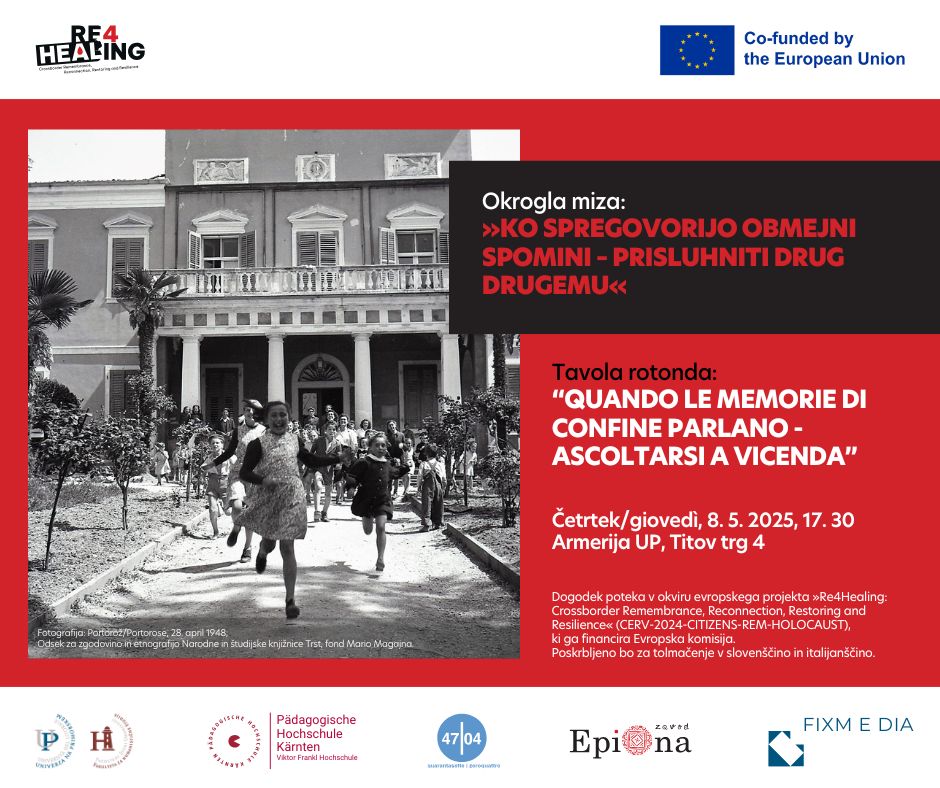
On May 8, 2025, the leading partner of the RE4Healing project organised a public roundtable based on deep discussion with eyewitnesses of tragic events on the Italian-Slovenian-Austrian borderland. Invited speakers – eyewitnesses who have experienced fascism, Istrian exodus and Nazism – provided testimonies that opened up the conversation about both intergenerational trauma and reconciliation that is needed for ethnically diverse communities to flourish. Speakers came from various affected groups: (a) Italian migrants of the exodus (Istrian Italians who migrated to Italy, esuli), (b) Italians who stayed in Yugoslavia after exodus and became a national minority, (c) people who migrated to emptied towns in Istria from various parts of Yugoslavia, and (d) members of Slovenian minority in Italy who have experienced various layers of fascism and violence. The latter included testimonies of multiple generations of people who experienced the violence of border fascism and Nazism. Affected groups publicly confronted their different memories in order to encourage mutual comprehension, empathy and self-reflection, challenging dominant national narratives of the past and present. Acknowledging both systemic processes of exclusion and personal stories of pain, invited experts (such as ex. dr. Paolo Fonda, an established psychoanalyst from Trieste and member of the International Psychoanalytic Association; and Daniel Wutti, educational scientist and psychotherapist from Klagenfurt) provided their analyses of what they heard from testimonies in order to frame conflicting memories toward reconciliation and peace. The roundtable – that was organised in one of the affected environments – in the bilingual town of Koper/Capodistria in Istria, Slovenia, was recorded by the film production team and served as one of the starting points of the upcoming documentary film.
1. Invitation – UP FHŠ website: https://fhs.upr.si/okrogla-miza-ko-spregovorijo-obmejni-spomini-prisluhniti-drug-drugemu/
2. Media news – local newspaper Primorske novice (a larger article about the project with the announcement of the round-table): https://primorske.svet24.si/plus/na-valovih-znanja/preseganje-mej-s-poslusanjem-bolecine-drugega
3. Media news – local newspaper Regional Obala: https://regionalobala.si/novica/dogodek-s-stevilnim-obcinstvom-ko-spregovorijo-obmejni-spomini-prisluhniti-drug-drugemu
4. Media news – STA – Slovenian national agency: https://o-sta.si/37064/okrogla-miza-ko-spregovorijo-obmejni-spomini-prisluhniti-drug-drugemu
5. Media news – Radio Koper (a one-hour long interview about the project and the borderland problems): https://radiokoper.rtvslo.si/podkast/odprto-za-srecanja/106615882/175140430?fbclid=IwY2xjawLGFMxleHRuA2FlbQIxMQBicmlkETB5aFJTVDdrS2NZbklRb0ZvAR4psg5ZeFCOSv1FPoPytSsX3Xj4llGdDGxlqaAFpOh-5fbu3egqovaaHQDluQ_aem_8ZrvzI_RMUgUSmP6-GIx5w
6. Media news – Radio Capodistria: https://radiocapodistria.rtvslo.si/podcasts/calle-degli-orti-grandi/173250859/175128173
Work Package 5: Paths of Remembrance (completed)
WP5 engaged 49 participants from six different countries: Austria, Luxembourg, Ukraine, Slovenia, Russia, and Spain.
In this work package (WP), our partner organizations invited each other—and specifically students from the two involved universities—to participate in so-called “Paths of Remembrance” in the three border regions. Additionally, an encounter between students from the University of Primorska (UP) and the University of Teacher Education Carinthia (PHK), representing different border areas, took place.
Alongside our partner organizations—University of Primorska, University of Teacher Education Carinthia, and Quarantasettezeroquattro—local partners were actively involved in the program. These included:
- Arbeitskreis Freiheit-Svoboda Ferlach/Borovlje (www.ferlachborovlje.at)
- Denkamol/Spunij se (www.denkamol-spunijse.com)
- SPD Borovlje (www.borovlje.at)
- Mauthausen Kommittee Kärnten/Koroška (www.mkkk.at)
- Verein/Društvo Peršman (www.persman.at)
- Comunità Autogestita Della Nazionalità Italiana Di Isola (www.comunitaitaliana.si)
Their engagement enabled students to address buried and often concealed aspects of contemporary history.
The “Paths of Remembrance” were multi-day excursions in the current border regions of Slovenia, Italy, and Austria. These excursions aimed to familiarize young people—primarily students—with the project’s themes in greater depth. Student groups from Austria and Slovenia not only explored the shared history of the Alps-Adriatic region but also developed a deeper understanding of today’s border dynamics.
As project outputs, students prepared research diaries or oral and written presentations to analyze how younger generations engage with these sometimes challenging topics, including differences in conflict perception between men and women. In their reflections, students also addressed contested border memories and explored ways to construct reconciliation and peace-building narratives.
Visit of Klagenfurt/Celovec, Ferlach/Borovlje and other bilingual places in Carinthia/Kärnten/Koroška (AUT)
On October 17, 2025, the group of professors and students from Koper/Capodostria arrived early in the morning at the site of the former Loibl/Ljubelj concentration camp. Dr. Daniel Wutti from the University of Teacher Education guided them to both sides of the former “twin concentration camp” of nacional socialists, which are now located in Slovenia (Ljubelj/Loibl South) and Austria (Loibl/Ljubelj North). The discussion focused on how different nations have dealt with their traumatic legacies: in Austria, as a perpetrator state that has long struggled to come to terms with this history, and in Yugoslavia and Slovenia, where the communist regime declared victory over the Nazi fascists as a defining part of national identity. On both sides of the border, however, the uncomfortable aspects of history were suppressed, a situation that societies are still grappling with today. The excursion continued to the Peršmanhof in Bad Eisenkappel/Železna Kapla. This is where one of the last Nazi war crimes against (Carinthian Slovenian) civilian population in Kärnten/Koroška took place. Today, the site remains the only museum in Kärnten/Koroška that addresses the publicly suppressed history of the Carinthian Slovenian resistance and the deportation of Carinthian Slovenes. This was followed by a bus tour through bilingual towns such as Šmihel/St. Michael Ob Bleiburg and Pliberk/Bleiburg, where the narratives of memory from the majority and minority are slowly converging into more inclusive stories—positive examples. The evening concluded in Klagenfurt/Celovec.
On October 18, 2025, a city walk tracing Slovenian and Jewish remembrance culture took place in Klagenfurt/Celovec. Both minorities are rarely visible today in the Carinthian capital—Jewish culture was literally completely destroyed during the Nazi era, and the Slovenian language is now slowly gaining general acceptance after decades of discrimination. This is rarely discussed publicly in Carinthia/Koroška; so far, it has mainly been up to NGOs and private initiatives to erect commemorative plaques and monuments and to bring this topic to the public’s attention through art and culture (literature, theater, art). Much of this is driven by members of minority groups—Carinthian Slovenes—but it is increasingly becoming bilingual; here, too, there are positive trends, albeit slowly. This was followed by a visit to Ferlach/Borovlje, where local bilingual initiatives were presented and Slovenian remembrance culture is also becoming more public, albeit slowly and still highly controversial in some quarters. Following this, the entire group traveled on to St. Jakob/Šentjakob, where a bilingual feminist group of committed women has been working for years to contextualize a monument—one “ideologically embellished” by the Nazis—that casts a shadow over the townscape. The group has already achieved a great deal here, but there is still resistance from Carinthian German nationalists who are hindering actual progress. After a snack, the visitors slowly made their way home, enriched both professionally and personally.
Visit of Koper/Capodistria, Izola/Isola, Piran/Pirano (SLO), Trieste/Trst and Gorizia/Gorica (ITA)
On April 17th, 2026, the University of Primorska in Koper/Capodistria (Slovenia) welcomed our partner Dr. Daniel Wutti and his students from the University of Education in Klagenfurt/Celovec. The program was as follows: We began with an introductory lecture on the topic “Memories and Silences on the Slovenian-Italian Border” by Prof. Dr. Katja Hrobat Virloget with the purpose to illustrate the students on the convoluted and traumatic history of the communities (Slovenian, Italian, Croatian) inhabiting the region they were visiting. After the presentation, the historian Assoc. Prof. Dr. Petra Kavrečič Božeglav gave a presentation on the history of Koper elaborating even further on the complex ethnic and national identity footprint in terms of its inhabitants. She presented on how the changing of borders in different historical periods has affected the communities living on the territory. We then continued the walking tour of the city of Koper/Capodistri where we visited various memorial contested sites. In addition to the Austrian students, also 1st year students from our anthropology department UP-FHŠ attended the presentation and joined the tour of the city. We had lunch and afterwards we went on a bus ride to Izola/Isola where we visited the association of Italian minority, Comunità Autogestita Della Nazionalità Italiana Di Isola (CAN). Here the Mrs. Martina Gamboz gave a presentation on the history of the community and its current situation. Our excursion continued with a visit to Piran/Pirano, where among others the local cemetery was presented as an Italian heritage site. At the end of the excursion, Dr. Daniel Wutti and his student continued their “Paths of Remembrance” journey to Trieste where our partner dr. Štefan Čok was expecting them.
On April 18th, 2026, Quarantasettezeroquattro organized a guided walk through the cross-border area of Gorizia-Nova Gorica. The participants discovered the history and the different memories of the area through the open-air, cross-border museum Topographies of Memory, developed by Quarantasettezeroquattro. The museum consists of 10 totems located in relevant places of remembrance in both cities, where visitors can discover the places through traditional instruments (written explanations in Italian, Slovenian and English) and multimedia contents (through a QR code linked to the website https://www.topografiedellamemoria.it/). At the end of the guided tour, the participants also discovered the multimedia exhibition Lasciapassare-Prepustnica (https://www.quarantasettezeroquattro.it/lasciapassare/ ), developed by Quarantasettezeroquattro for the municipality of Gorizia, in the building of the old Italian border control point called Rafut. The exhibition consists of a video integrating pieces of the post-WWII Italian and Yugoslav official narratives (visitors can see the same events through the propaganda of both countries) and interviews with inhabitants of the border area, available in the original language and with double subtitles (so all the contents are again available in Italian, Slovenian and English). Through the guided tour to Topographies of Memory and Lasciapassare-Prepustnica, the participants had the opportunity to deepen their understanding of the border area and of how the different memories of the past are still influencing the present day.
Deliverable:
- https://fhs.upr.si/obisk-studentov-iz-celovca/
- https://www.facebook.com/up.fhs/posts/pfbid025n4PLKnmdiQs1fYuFBoTRo9NnzZ7vt1wHLPp4TjbkSjech7LbNVhEYKoibFVgHjYl
- https://www.instagram.com/p/DXqq8PMFtow/?fbclid=IwY2xjawRdQKNleHRuA2FlbQIxMABicmlkETFYM3JKd3FvbGZsS0xtY2psc3J0YwZhcHBfaWQPNTE0NzcxNTY5MjI4MDYxAAEeLNgXBawRRWObGwC9cWsG71aNahnZMnP3hu85I5gOs-SPDZDK1ABUWgMMjvo_aem_Harh25ciKQETGn0t1BwsMg
Work Package 6: Between history and memories of the Upper Adriatic Area (completed)
Lead Beneficiary: Quarantasettezeroquattro (47-04)
WP6 brought together 65 participants from five countries: Slovenia, Austria, Croatia, Canada, and Italy.
On January 23, 2026, and January 24, 2026, Quarantasettezeroquattro organised a public event in Trieste and Gorizia. The aim of the event was to create an opportunity for discussion about the complex topics of history, memories, and places of remembrance, through an approach of empathy and understanding of the tragedies of the past.
On both days, the event consisted of guided visits (a walk through the city center of Trieste and a visit to an exhibition in Gorizia-Nova Gorica) and discussions. The aim was to invite the participants to reflect on the connection between the public policies of remembrance, personal remembrance, and public spaces: who decides what should be remembered and how it should be remembered? And how do these politics of remembrance affect a space where different memories of the past are present, some of them being not fully included and/or recognized in the public discourse? The round table in Trieste had the main aim of creating a context where the different communities living in the border area could have the possibility to interact together; at the discussion in Gorizia-Nova Gorica, the aim was to have a moment of critical evaluation of the long-term impact of the European Capital of Culture with regard to the politics of remembrance.
MEDIA LINKS:
Invitation:
- https://www.quarantasettezeroquattro.it/evento/luoghi-memorie-comunita/
- https://www.quarantasettezeroquattro.it/evento/luoghi-memorie-comunita-2/
- https://www.facebook.com/quarantasettezeroquattro/posts/pfbid02YExbvUwsqQqdFSFD6oMFpwTfFJjeDghAzCKSevxrVvNcDmUfdii7czDYqRwQE6s8l
- https://www.facebook.com/quarantasettezeroquattro/posts/pfbid02bKqyXDZcfZbYAnBfUVuE1KW2X345zCJM6uMJSh3RjkzEhnVbk9Kec8SsHBxhRFwpl
- https://www.facebook.com/quarantasettezeroquattro/posts/pfbid02KW3VsEQkVHgksbgUjBsrL7AjTB8hozUMJ1dQ15DRqPZqp8NDnARvWTFbD4iuKqRyl
Press coverage:
- https://www.nordest24.it/luoghi-memorie-comunita-evento-trieste-gorizia-nova-gorica
- https://www.ilpais.it/2026/01/19/luoghi-memorie-comunita-tra-passato-futuro-delle-terre-di-confine/
- https://triestecafe.it/it/news/eventi/trieste-gorizia-e-nova-gorica-unite-da-storia-e-memoria-ripercorriamole-assieme-19-gennaio.html
- https://www.nordestnews.it/2026/01/19/luoghi-memorie-comunita-tra-passato-futuro-delle-terre-di-confine-due-giorni-di-eventi-tra-trieste-gorizia-e-nova-gorica/
- https://www.turismofvg.it/eventi/luoghi-memorie-comunita-tra-passato-futuro-delle-terre-di-confine-476017 (the webpage cancels the past events, the screenshot is available with the screenshots of the printed media)
- https://www.il-meridiano.it/eventi/19358-luoghi-memorie-comunita-trieste-gorizia-e-nova-gorica-unite-in-un-percorso-transfrontaliero.html
- https://primafriuli.it/luoghi-memorie-comunita-evento-trieste-gorizia-nova-gorica
- https://friulivg.it/2026/01/21/luoghi-memorie-comunita-tra-passato-e-futuro-delle-terre-di-confine-due-giorni-di-eventi-a-trieste-gorizia-e-nova-gorica/
- https://www.informatrieste.eu/ts/blog/luoghi-memorie-comunita-tra-passato-futuro-delle-terre-di-confine/
- https://www.udinenews.net/luoghi-memorie-comunita-due-giorni-tra-trieste-gorizia-e-nova-gorica-per-rileggere-il-passato-delle-terre-di-confine/
- https://www.ilpais.it/2026/01/22/luoghi-memorie-comunita-tra-passato-futuro-delle-terre-di-confine-2/
- https://www.ilgoriziano.it/articolo/tra-eredita-di-go-2025-e-nodo-delle-memorie-le-due-gorizie-cuore-del-dialogo-transfrontaliero-22-gennaio-2026
PRINTED MEDIA: https://fhs.upr.si/wp-content/uploads/2026/08/WP6_RE4Healing_printedmedia_2324012026.pdf
Work Package 7: Dissemination and discussion of the documentary in Italy
Lead Beneficiary: Quarantasettezeroquattro (47-04)
The documentary realized in the first half of the project will be a tool of further discussion about the topics of the project. The main target group will be the young population, especially the secondary school students. The objective is to encourage the students to deal with the different traumatic memories of the past, to understand that the different communities share some common aspects of how to remember the tragedies of the 20th century but they have also deep differences, sometimes also conflictual differences in the remembrance.
The workshops will take place in Italian and Slovenian speaking schools. Because of the linguistic barrier (only few Italian students speak or understand Slovenian and the Slovenian language is not present at all in the Italian speaking schools) and of the necessity to give to all the students the possibility to interact in their mother language – the equal status of both languages is a really important issue in terms of human rights- two parallel series of workshops will be developed, the first in Italian, the second in Slovenian. The second objective is to promote a deeper understanding of the tragedies of the past through a public screening of the documentary during one of the summer festivals organized by Quarantasettezeroquattro in the border area.
Work Package 8: Workshops & Film shows from the educational, psychotherapeutic and anthropological perspective
Lead Beneficiary: University of Primorska
The younger generation, pupils and students, play an important role in the project. As part of this project, specially organized school workshops in Slovenia, Austria and Italy will be held in cooperation with selected schools and universities in the defined border areas to familiarize pupils with historical positions and current aberrations of the topic. Minority schools are also important here, e.g. secondary schools of the Slovenian minorities in Austria and Italy, but also schools of the so-called “majority population” of the participating partner countries and others with similar problems (e.g. Croatia). The project team will show the specially produced documentary film and the topic will be prepared in advance with selected teachers. After the screening of the documentary, the topics will be dealt with in a sensitive and differentiated manner in workshops based on the anthropological, historical and psychotherapeutic approach. We will also broadcast the film and the discussion to a wider audience if the opportunity arises, also in the university and school environments workshops will be open to a wider interested public. The discussions will be performed in universities and schools in Slovenia, Austria, Italy and Croatia (or other). The Cultural Heritage Directorate of the Ministry of Culture, Slovenia will help disseminate the message through its wide networks.
Work Package 9: Connected through music: concert on the border + discussion
Lead Beneficiary: Institute Epiona
Music, when written and composed sensitively and with meaning, can be widely accepted and offer profound collective healing experiences, helping to dissolve divisions within communities and can provide a significant catharsis. In the second year of our project, this work package aims to disseminate the documentary and our research findings through a concert. We believe it is essential to address personal stories with compassion and advocate for a transborder perspective, free from hate and nationalism. To this end, we have decided to create this disseminating event, where we will show the documentary and make a cross-border concert. The lead musician at the moment is Toni Bruna, a singer and songwriter from Trieste whose songs (in Trieste’s dialect) reflect on border traumas through his family’s personal experiences, where his family settled in the outskirts of Trieste after WWII as esuli (migrants of the Istrian exodus). We will add other musicians and artists to the concept, further developing the idea of representing all minorities in the region, this will help us to address the topic from the perspective of art and collaboration.
Work Package 10: Ethnography of Silence: International Conference
International conference: Ethnography of silence(s)
September 1-3, 2026, Faculty of Humanities, University of Primorska, Titov trg 5, 6000 Koper/Capodistria, Slovenia
Lead Beneficiary: University of Primorska
—
The three-day interdisciplinary conference featured more than 25 presentations by researchers from eight countries eligible under the CERV programme (from a total of 12 countries around the world). Silence was explored from a wide range of perspectives.
The conference was the result of two ongoing and complementary projects, on one side the anthropological project of the partner leader Ethnography of Silence, financed by the Slovenian National Agency for Research and Innovation (ARIS J6-50198),) and the CERV project Re4Healing: Crossborder Remembrance, Reconnection, Restoring and Resilience (European Commission, Citizens, Equality, Rights and Values Programme [CERV]). The support was also from the research and infrastructure programme Heritage as an Object and Reflection of Social Processes (ARIS P6-0460). The first project is focused on the anthropological research of silenced societies (from the borderland to other minoritarian, post-colonial, post-industrial frames), while CERV project presents the applied results of the research focused on the borderland silences. The conference was interdisciplinary, reaching out from anthropology to history, educational sciences, social psychology, law, hritage science, and sociology.
It began with a panel entitled “Memories and Silences in Borderland Regions,” which was directly linked to the RE4Healing topic. This was followed by a screening of the film Shadows of Silence and a roundtable discussion exploring the meaning and themes of the film. The other panels were entitled “Memory, Conflict and Trauma,” “Silence and Structural Violence,” “Approaching Silence in the Indigenous World and Beyond,” and “From Silence to Resistance.” The conference concluded with a Closing Roundtable “Towards Reconciliation” which is the final aim of the Re4Healing project.
A particularly new perspective in our region was the Indigenous perspective, presented by the distinguished Māori scholar Tracey McIntosh from the University of Auckland. She spoke about silence as a form of violence and repression, about indifference, and about how silence becomes violent when those who know remain silent. Silence was also examined as a survival strategy and as a form of protection from pain. In the context of the post-war killings, the discussion focused on the silence of those who had been humiliated. Psychoanalyst Pavel Fonda also pointed out that silence is often necessary, as it is important to wait for the right moment before we can speak. The question of when and who speaks was explored by Kathrin Pabst from Norway, who has observed how the things left unspoken can have profound psychological consequences across several generations within families. Michèle Baussant from France, the third of the above mentioned keynote speakers, also pointed out that recognition of injustices can come too late and can amount to little more than a superficial political gesture, beneath which inequalities and discrimination continue to persist. For the European context, it was particularly valuable to encounter neglected and marginalized Indigenous epistemological frameworks, which Marko Galič brought into the discussion as possible pathways towards reconciliation between different ethnic and other groups. As Kathrin Pabst observed, the conference paved the way for an approach that academia should embrace: towards interdisciplinary and courageous research, and towards dialogue between established academic traditions and Indigenous knowledge systems.
A total of 40 people from nine countries participated in WP10: Italy, Slovenia, Serbia, France, Austria, Croatia, Poland, Hungary, and Finland.
Project documentation
Project data
Project title: RE 4 Healing: Crossborder Remembrance, Reconnection,
Restoring and Resilience
Acronym: RE4 Healing
Project type: CERV Lump Sum Grants
Project coordinator: Univerza na Primorskem, Fakulteta za humanistične študije / University of Primorska, Faculty of Humanities
Project leader: prof. dr. Katja Hrobat Virloget
Project partners:
Zavod Epiona;
Associazione Culturale Quarantasettezeroquattro;
Pädagogische Hochschule Kärnten;
Fixmedia, Zavod za razvoj filmske ustvarjalnosti Ljubljana;
Cultural Heritage Directorate Ministry of Culture, Slovenia (associated partner)
Financing: European Commission, Citizens, Equality, Rights and Values Programme (CERV)
Duration: 1. 3. 2025-28. 2. 2027
Funded by the European Union. Views and opinions expressed are however those of the author(s) only and do not necessarily reflect those of the European Union.Neither the European Union nor the granting authority can be held responsible for them.