The first bishop of Koper, St. Nazarius, was consecrated Bishop of Koper in 524. Thus, this year is associated with the foundation of the city. The Municipality of Koper, as the promoter of the “Koper 1500” project, invited a number of partners, including the UP Faculty of Humanities and the UNESCO Chair in Interpretation and Education for the Promotion of Integrated Approaches to Heritage, to participate in the design and implementation of the project. In December of 2023 a press conference was help at the Koper Regional Museum where the institutions presented their activities in the jubilee year. The UP FHŠ and the UNESCO Chair are involved in the programme through several activities, including an international conference on heritage interpretation, international summer schools, exhibitions in the Little Lodge and public lectures.
Connected activities:
Students open the Symbols of Koper exhibition, 07.05.2024
In 2024 Koper celebrates its 1500th anniversary. The historic city is marking the anniversary with numerous cultural and other events, and an exhibition ‘Symbols of Koper’ by students of the Faculty of Humanities of the University of Primorska is also part of the celebrations. During the Art Heritage of Antiquity course students, under the mentorship of Assist. Prof. Dr. Katarina Šmid, prepared the exhibition ‘Symbols of Koper’. It brought visitors closer to the most important symbols of the city, linked to its rich history, the most recognizable of which are the Medusa, the Goat, the Sun, the Justice and St Nazarius. The exhibition was on display at the Mala Loža, an open-air street gallery, just a step away from the central square of Koper – this location allowed to attract the attention of the wider audience.
Public presentation of the renovation process of the Servite Monastery in Koper, 22.05.2024
On 22 May, 2024, the building of the former Servite Monastery in Koper hosted a presentation on the progress of the renovation of this large historic building of national importance, due to the great interest shown by the public. First, Prof. Dr. Rok Strašek, Vice-Rector of the University of Primorska, greeted 160 visitors on behalf of the Rector. Then experts from various fields comprehensively presented the renovation project from all angles.
Architect mag. Eva Prelovšek Niemela from the Innorenew CoE research institute presented in detail all phases of the renovation, which began in 2021, and the contents that will come to life in the renovated building. So far, a lot of construction work has been carried out: from the installation of a new roof, to the arrangement of storm sewers and the injection of walls, which stopped the deterioration of the building. Extensive research was also carried out into the statics of the walls, the structure of plaster and paintings, which was followed by archaeological excavations. The investment in the listed works amounted to two million euros, contributed by the Ministry of Culture, the Ministry of Higher Education, Science and Innovation and the university. The renovated monastery complex will serve not only the needs of researchers, teachers and students of the University of Primorska, but also the residents of Koper and the wider public. In addition to the premises for university activities, it will also house spaces intended for various events, an auditorium, a reading room, a café, a virtual reality laboratory and a museum collection.
Jaka Bizjak, an archaeologist and conservator from the Institute for the Protection of Cultural Heritage of Slovenia (ZVKDS) in the Piran Regional Unit, revealed what was found during the archaeological excavations. The findings show that on the site a luxurious Roman seaside villa – Villa Marittima – dating from the 1st century AD was located. He listed some of the interesting finds from different periods: wall plaster with frescoes, a tegula with a maker’s stamp, an antefix, pot fragments (all 1st century), a Byzantine belt buckle (2nd half of the 7th century), remains (12th-14th centuries), fragments of pottery and bottles (15th-18th centuries), incense taps and parts of a plate (19th and 20th centuries). Dr. Mojca MarjAna Kovač, Conservator in charge of the ZVKDS, spoke about the art-historical evaluation of the monastery building, about the guidelines and the conservation orientations, which can be determined on the basis of its social significance. Eva Prelovšek Niemela, Dr. Jako Pečnik, Dr. Črtomir Tavzes and Assist. Tim Mavrič presented the equipment needed for determining the mechanical properties and moisture content of materials (focusing on wood), for scanning rooms in 3D and for using a thermographic camera. The results of the fungi (mold) sampling carried out in the monastery building were also presented. Fortunately, fungi which cause only soft decay and discoloration and are not classified as pathogenic wood-degraders were found in the monastery.
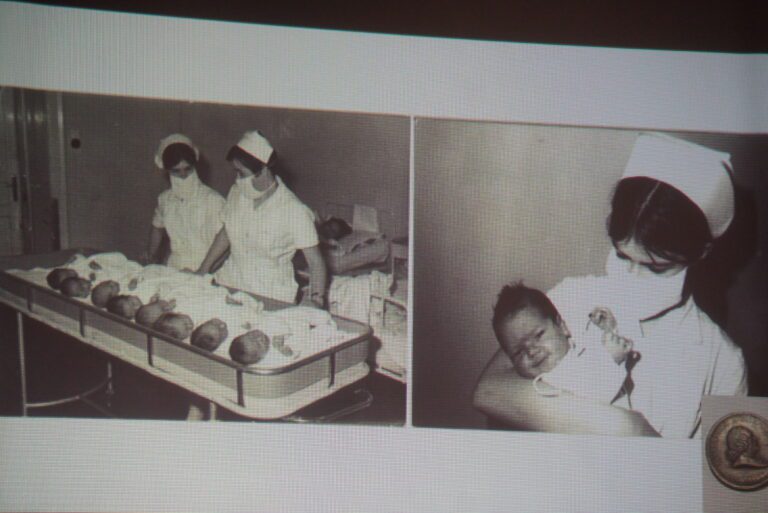
Assist. Prof. Dr Neža Čebron Lipovec (UP FHŠ and the UNESCO Chair) presented ethnological and anthropological research on the significance and recent history of the monastery as a hospital and maternity hospital, inviting those present to a discussion and exchange of views on the significance of this monument. In the minds of the local population this building has become a lasting memory as a common birthplace. Those present received commemorative postcards and were invited to sign the commemorative book, both paper and online. The university looks forward to new entries and to sharing memories in pictures and words via the electronic memory book. After the tour, the guests expressed their interest in the work done so far and their wish to see the building renovated as soon as possible. The new story of the Servite Monastery is being born.
The university’s wholesome approach to the conservation of this monument is an exemplary case of integrated approach to heritage that brings together experts from a wide array of disciplines as well as different stakeholders, primarily the local community.
The exhibition ‘Modernist Koper’ in Mala Loža, 12.07.2024
Modernism in architecture encompasses several so-called “modern movements”, and the common denominator of all of them is the search for radically new answers in architecture to the questions posed by the modernization of society and the world. It was only after World War II that comprehensive solutions in the spirit of modernism were brought to northern Istria, and especially to Koper. Due to the unique political development of post-war Istria, especially due to the existence of Zone B of the Free Territory of Trieste, post-war architecture and urbanism today represent a unique phenomenon within Slovenian architecture.
The exhibition presented the urban and architectural plans of ‘Modernist Koper’ through three sections rounded off in three time periods: the Time of Zone B of the Free Territory of Trieste (1947–1954), the First Years as part of Yugoslavia (1954–1957), the Time of Edo Mihevc (1957–1967).
The authors of the exhibition are Assist. Prof. Dr. Neža Čebron Lipovec (UP FHŠ and the UNESCO Chair), Advisor to the Mayor for Culture and European Projects of the IOC, Vesna Pajić, and mag. Nada Čibej, Director of the Koper Regional Archive.
Midwifery Once and Today: “Midwifery is a prototype of cooperation between women, 11.09.2024
- https://fhs.upr.si/vabilo-na-okroglo-mizo-in-spominski-klepet-babistvo-nekoc-in-danes/
- https://fhs.upr.si/babistvo-nekoc-in-danes-babistvo-je-prototip-sodelovanja-med-zenskami/
On the occasion of the International First Aid Day, the University of Primorska organized the event Midwifery Once and Today, which took place in two parts. In the morning, a round table on midwifery, moderated by Assist. Prof. Dr. Neža Čebron Lipovec (UP FHŠ), was held at the Faculty of Humanities, where experts from various fields discussed midwifery as a heritage and a profession. Among the participants were Dr. Zalka Drglin (National Institute of Public Health), Špela Spanžel (Director General of the Directorate for Cultural Heritage), Saša Matko (President of the Nurses and Midwives Association at the Chamber of Health and Midwifery of Slovenia), Tamara Bači (Izola General Hospital) and Assoc. Prof. Mirko Prosen (UP FVZ). But at first a short documentary film ‘Midwifery: Knowledge, Skills and Practices’ was shown. It was produced as part of the celebrations of the successful multi-national nomination of midwifery on UNESCO’s Representative List of the Intangible Cultural Heritage of Humanity. This link between midwifery and heritage makes the role of The UNESCO Chair in Interpretation and Education for Enhancing Integrated Heritage Approaches in co-organizing the event all the more important.
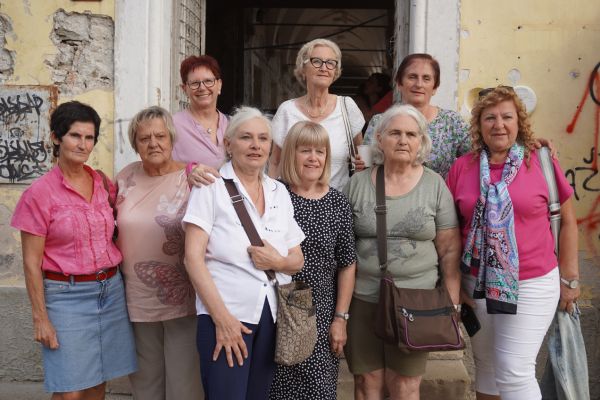
In the afternoon, the action moved to the former Servite monastery, where the Koper maternity hospital was located for almost 50 years. Participants were greeted by the Vice-Rector of the University of Primorska, Prof. Dr. Rok Strašek and the Dean of the UP Faculty of Humanities, Prof. Dr. Irena Lazar. It was followed by a brief historical presentation of the building of the former Servite monastery by Assist. Prof. Dr. Neža Čebron Lipovec, who shed light on the rich history of this building through various periods. Afterwards a “group memory talk” event of the retired midwives was dedicated to sharing their memories of working in this building.