
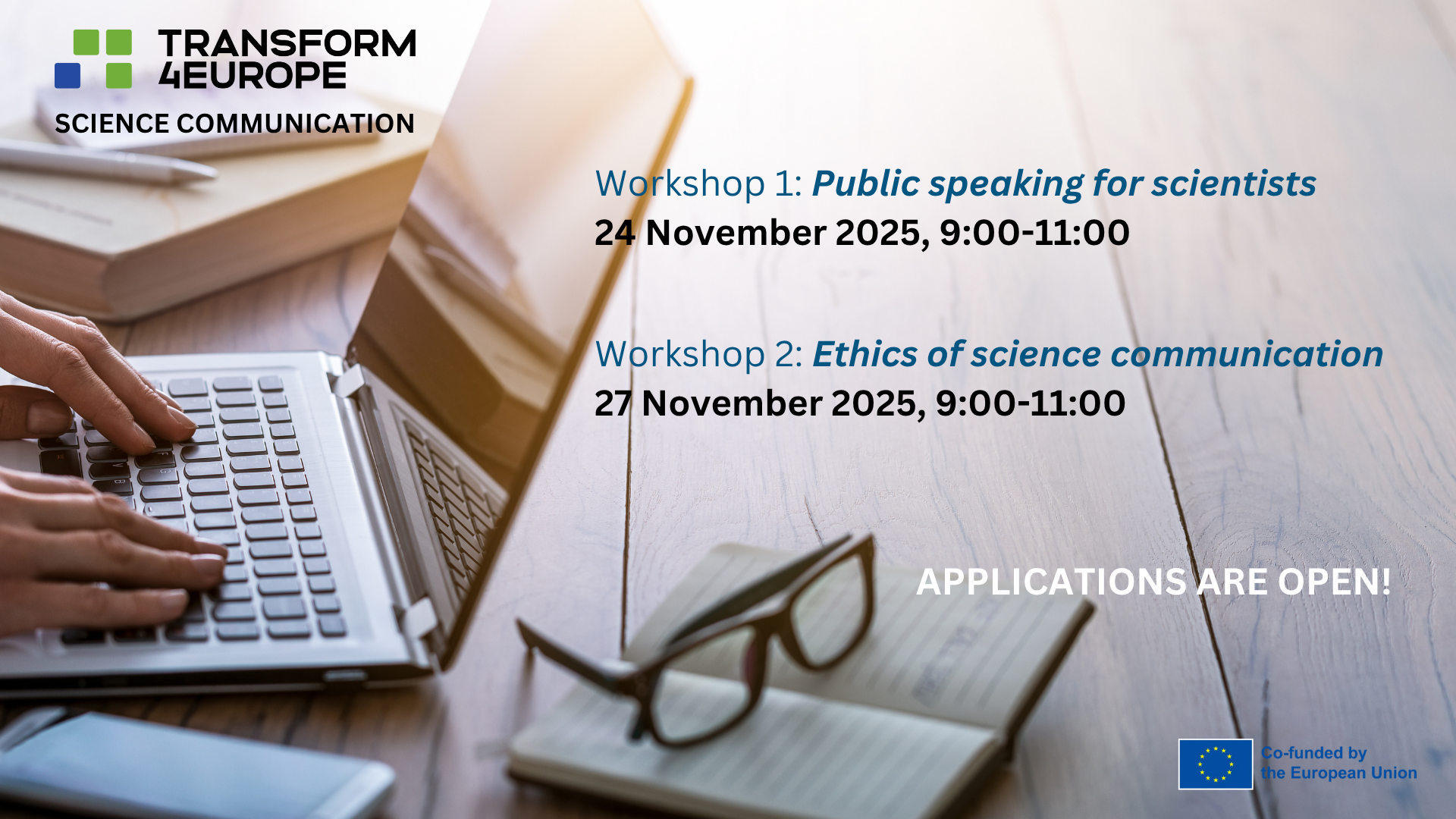
Both workshops will be held via Zoom in English language. Participants who complete the workshop are eligible to receive a certificate of attendance issued by T4EU.
Please apply via this link: https://forms.office.com/e/nErQb5JTd9
Application deadline: 20 November 2025
For additional information please contact sanja.sandic@upr.si.
ABOUT THE WORKSHOPS:
Workshop 1: Public speaking for scientists
Trainers
Dr. Barbara Švagan, University of Primorska, Faculty of Management
Rok Hafner, the Slovenian national debate organisation »Za in proti«
Date
24 November 2025, 9:00–11:00 (CET)
Target Audience
Researchers and students
Description
In this workshop, we will focus on the fundamentals of effective public speaking in both academic and professional contexts. Participants will learn how to structure a clear and engaging presentation, adapt their speaking style to different audiences, and communicate complex ideas with confidence and clarity. We will discuss the importance of strong public speaking skills in academia, whether when lecturing, presenting research, or representing the institution, and explore practical ways to overcome common challenges such as stage fright or unclear messaging. The session will combine practical tips, short exercises, and reflection to help participants strengthen their presence, improve delivery, and become more impactful communicators.
Workshop 2: Ethics of science communication
Trainer
Dr. Karolina Babič, University of Primorska, Faculty of Education
Date
27 November 2025, 9:00–11:00 (CET)
Target Audience
Researchers and students
Description
When thinking about science ethically, we often focus on research ethics, clinical trials, or future applications. Yet ethics also concerns science as a human endeavour shaping how societies and humanity understand themselves. From this view, we ask: How does science define what it means to be human? How do ethics and science intersect in questions of truth, justice, or technology? What assumptions shape science’s role in society, and why have facts and truths become unstable in public discourse? These issues concern how science reflects on itself, its ties to power and politics, and how it is perceived by society—key themes for philosophical and ethical inquiry into science communication and self-reflection.