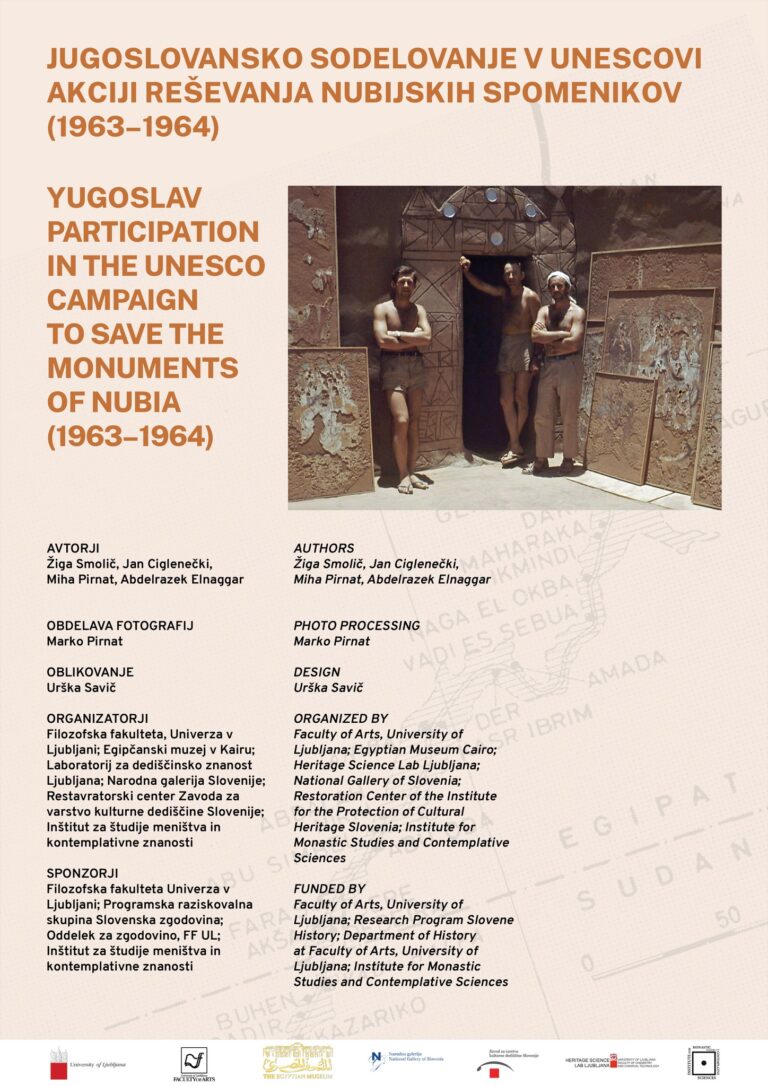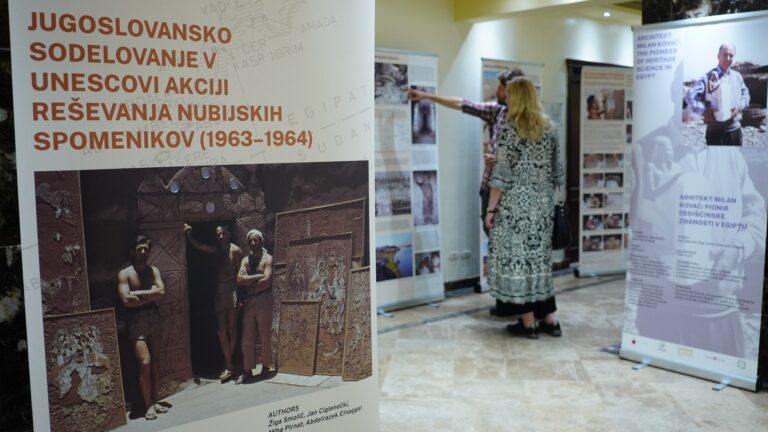
The involvement of Slovenians in the field of research into the heritage of ancient Egypt has been sporadic throughout history and, as a rule, without the support of the relevant institutions, which is why Egyptology as a science has not developed systematically in our country. Nevertheless, from the mid-19th century to the present day, Slovenians have actively participated in the discovery and preservation of cultural monuments in the land of the Nile. Some exceptional, but almost forgotten stories are worth presenting to experts and the wider public, and among them is the Yugoslav expedition (1963-1964) that took place within the framework of UNESCO’s preservation of the monuments of ancient Nubia. This is the subject of an exhibition prepared by Žiga Smolič, Dr. Jan Ciglenečki, Miha Pirnat (Jr.) and Dr. Abdelrazek Elnaggar.
During the exhibition, we will organize accompanying lectures by the authors of the exhibition; the first will be on October 28, 2025, by Doc. Dr. Abdelrazek Elnaggar, who will present the significance and progress of UNESCO’s global campaign to save the Nubian monuments.
The exhibition will then be moved to the InnoRenew CoE center in Izola as an accompanying program to the Third Annual E-RIHS.si Conference, organized by UP FHŠ, which will take place on November 18 and 19, 2025. The conference is co-organized by InnoRenew CoE and ARIS Projekt Aid hch.
More:
The area between the first and second cataracts of the Nile, together with numerous exceptional archaeological sites, was increasingly threatened by rising water levels due to the construction of the large Aswan Dam. Yugoslavia participated in a major international campaign to rescue archaeological monuments, which was carried out under the auspices of UNESCO. The primary task of the expedition was to photograph and restore Coptic frescoes found in churches from the period of the Nubian kingdoms (between 542 and 1323 AD), built in former Pharaonic temples. The members of the expedition, among whom the Slovenian restorer and painter Miha Pirnat, who played a key role, have discovered numerous previously unknown layers of wall paintings, under which reliefs and hieroglyphic inscriptions were hidden. Pirnat’s participation in these discoveries is considered the most important contribution of Slovenians to the exploration of Egypt in the 20th century.
Members of the Yugoslav expedition, which included Miha Pirnat, Milorad Medić, the head of the mission, Mihailo Vunjak, Bogdan Kovačević, and Jovan Nešković, removed 92 fragments of wall paintings between November 9, 1963, and May 31, 1964. Today, the frescoes are kept in Cairo, Aswan, and Khartoum. Unlike other countries that participated in UNESCO’s campaign, Yugoslavia, as a sign of brotherly friendship with Egypt and Sudan, waived compensation for the funds invested in the form of objects provided for this purpose by the governments of Egypt and Sudan.